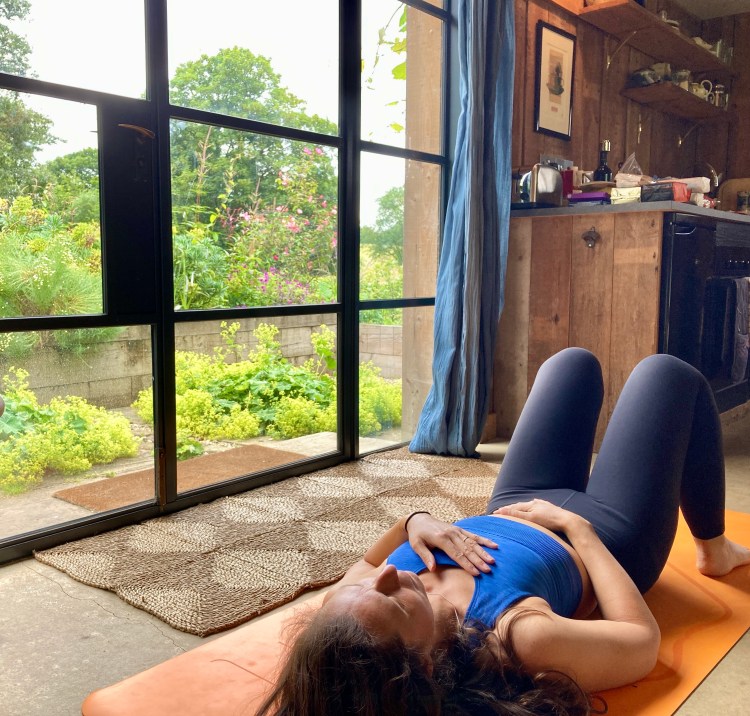
Breathing in the new year

I travelled a long way over the holiday period. I mean that literally, though it might also be true metaphorically as staying with family is often a time of heightened emotions, awareness of our interconnectedness and of the brief span of human lives — and how we love to complicate them!

But actually I’m simply referring to my first long haul flight since before Covid, flying to the opposite side of the planet to see family after some years apart. On the way home I did that peculiar thing of jumping timezones so that I had two if not three new year moments. For one of them I even managed a fizzy toast with my husband, settled in our airplane seats. It was a moment when we looked at one another, took in the event, the turning of a page in the calendar, and acknowledged the passage of time. In my heart I noticed the call to make a fresh beginning, to recommit to some good practices I’ve allowed to wane a little, to reconsider some habits I might benefit from dropping or lessening, and my imagination started playing out across some dreams and ambitions that I might lean towards later in the year.

It was a noticeable moment in time. A little pause that we took in together. In Sanskrit we might refer to this as ‘kshana’ (क्षण kṣaṇa), the smallest perceptible unit of time. I like to think the more times we can observe a ‘kshana’ the richer our experience is. This is the essence of mindfulness practices.

The wonder of kshana for me is that is it full of possibility. Each time I wake up to a moment, I am invited to begin again. It might be an inhale, a fresh new breath, or a deeper sense of embodiment. It might be a little glimmer of enlightenment, a subtle reorientation in my outlook. It might even be a sudden arrival of a plan, an urge, a project, something that inspires and calls me to creativity, action, or renewed alertness.
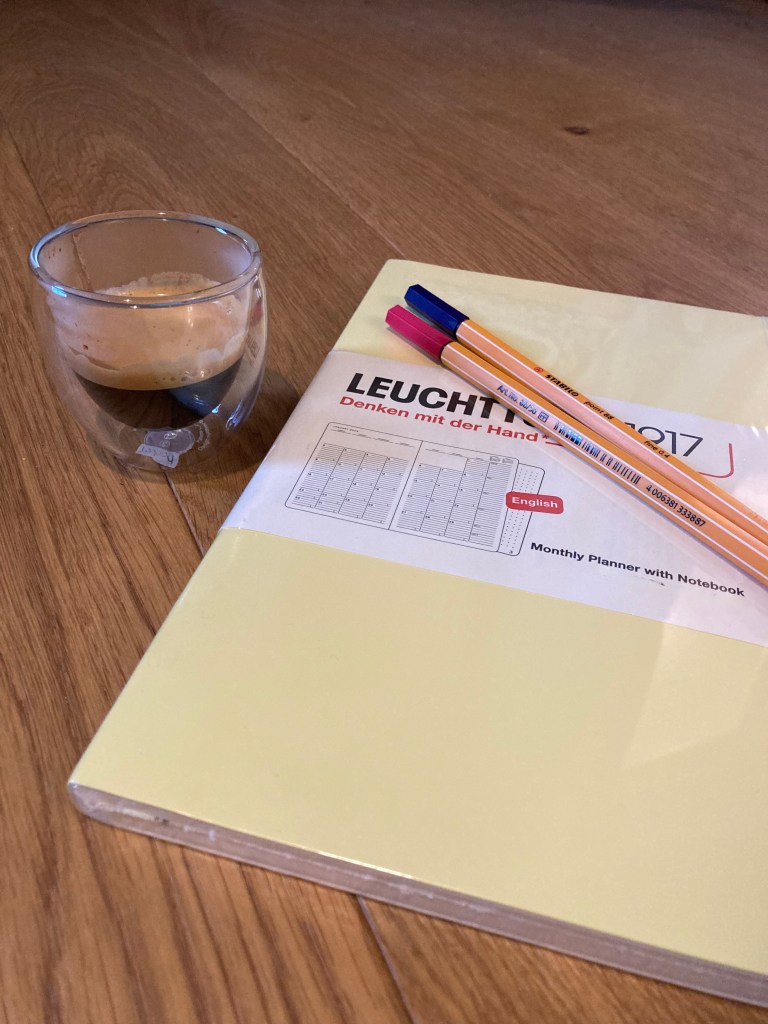
January is often a time for reflecting and planning. This can be wonderfully inspiring. I’m doing this too. I’m winnowing my lists and ideas and listening again to the voice inside that directs me away from too many grand gestures and more toward the quality of feelings I want to nurture throughout the year. That’s to say, I’m trying to make my commitments and plans on the level of intuition and desires and needs felt in my body, not just my willpower and intellectual ideas. This is taking time to feel into, it can’t be rushed.

And whatever January practices and rituals you might have for yourself, be alert for the occurrence of kshana, the tiny moment you notice. What is it telling you, what invitation does it offer, what horizon appears? This is a practice for any month, any moment. Just keep noticing each kshana and the space it opens up.

“Each inhale is a new beginning” as my first meditation teacher used to say.
Autumn = Fall

This year I have been meeting weekly with a group of students who mostly live in the US and I love how they talk about this season as ‘the fall’. In my ears the word is so evocative. The trees shedding their leaves, all gold and red and crispy underfoot. I can almost scent the woodsmoke in the air and picture the apple harvest and I imagine myself having cosy nights in, snuggled up with colourful blankets and something warming to drink.

In reality for me autumn doesn’t feel quite like that. The ‘fall’ is more a fall in my energy levels as the light levels and temperature dip. I used to fight my way against the autumn season… and then grit my teeth a bit more to survive the wintertime!

In recent years I’ve been practising a bit more acceptance and ability to flow with the seasons, to live more in harmony with the natural world. I now work with my energy rather than against it. It’s taken years of deep listening (aka yoga) to become sensitive to my needs, rather than denying how I feel and trying to power through it. Some days that means my yoga practice is slow and quiet, nourishing me when my energy is low, cultivating gratitude towards the darker seasons which provide more opportunity for resting. Other days I feel my energy could do with a boost and I know that a more vigorous practice will lift me up emotionally and warm me up physically, so I’ll turn up some invigorating music at home or go to a class where other people will energise me.

  • Make a list “10 things I love about autumn.” You can keep the list and come back to it if the short days are getting you down. This can also be an inspiration for autumn activities you’ll enjoy.
  • Change up your diet to include. nourishing, warming foods and local seasonal produce. Inspire yourself by seeking out new autumn-inspired recipes.
  • Choose some themed reading to get you in the mood for the various festivals of the season or find a book which evokes the more pleasant aspects of the time of year. Some people love autumn and write so beautifully about it!
  • Get outside as much as possible and make the most of the more limited sunlight. Kick up the autumn leaves feeling like a kid, wear warm and waterproof clothing so you stay comfortable and don’t deplete yourself fighting the cold and damp. Cheerful colours can also help!
  • Let go of the fashionable cold water plunges and luxuriate in a hot bath. Be liberal with body oil or lotion afterwards. Bonus points for candles in the bathroom.
  • Cultivate home hobbies in the dark evenings like reading or crafts, perhaps join an online class to learn a new skill from the comfort of home.
  • Watch TV. Don’t roll your eyes judgmentally at this one! Downtime like this can be just what’s needed, enjoying the interest of a new box set or resting into the comforting nostalgia of an old favourite film or show. You can invite a friend over for company as socialising can also be a great mood boost (for them as well as you!).
photo credit Ania Ready

Yoga as Self Care

What does self care mean to you? If anything…?

For myself, I think I went a long time in my life without consciously caring for myself. Self care sounded a weird idea, not something I felt I particularly needed. I got by OK and that was enough for me. Partly this might have been true in my younger days(!) but partly it was because I didn’t really understand what I was missing and I was simply used to powering through life, meeting all the more obvious needs that cropped up for me. Work, family, friends and so on.

What is self care anyway? Popular media suggested it is bubble baths and Netflix on the sofa with a bar of Dairy Milk. Or spa weekends with the girls. Or, a bit more subtly, learning to say ‘no’ to the demands of others when appropriate or necessary, Self care can be all these things of course! And many more. I’m sure you already have your own self care ideas. But it look me a long time to begin to figure this out for myself. I’m still learning and, of course, my needs are changing too which keeps it all very interesting.

Looking at self care through the perspective of yoga suggests to me that true self care (as opposed to self indulgence or ‘feel good’ activities) is born from self awareness. We have to learn how to listen into our needs in order to know the best way to look after ourselves. This process of learning how to listen in is how I think of yoga — yoga is the art of paying attention. This is called svadhyaya in Sanskrit which literally means ‘self-listening’. On the mat or the cushion, we’re spending time observing our thoughts and our feelings, our reactions to what happens in our practice, feeling into our physical body and the sensations there — and this is all ‘data’ for understanding what we need to respond more skilfully to how we are in each moment.

For some people a slower form of yoga can be a helpful place to explore and practise self-reflection and inner listening. There’s less going on as we do a smaller number of poses, and this can make deeper listening more possible with less emphasis on movement, keeping up with the sequence, or ‘getting it right’.

In restorative yoga class I offer variations of poses or different ways to use props (like cushions and blankets) that can give a space for curiosity and personalisation of your practice. As we always include some longer-held poses, there’s more time to settle in deeply to the point where the nervous system begins to shift. This shift or down-regulation can offer some insight into what deeper rest (meaning rest through the whole system, not just in the muscles) feels like. With that experience to guide us, with that taste of deeper rest, we might gain some clarity or insight. This ‘data’ can bring us to more discerning choices in our lives. Often times we need more rest, we just don’t want to acknowledge that (like an over-tired toddler!). And even if that’s not the case for you, a bit of downtime will still set you up well for the next adventure and perhaps allow you to appreciate more fully the vibrancy of those energy-filled moments.

I offer a space each month for this kind of self-listening practice, in the form of a short online restorative class. There’s a suggested donation but you can pay whatever amount is right for you. Book your place for the next class here or get in touch if you have any questions.

Give yourself a helping hand in meditation

There’s a pun in the title! Meditation is all about thoughts — or so we might think! And in some ways that might be true. But being with our thoughts (let alone trying to slow them down or even change them!) can be difficult and abstract. How about we give ourselves a helping hand — quite literally — and make the practice easier to grasp (another pun, sorry).

Mudras and mala beads

Involving part of the physical body can be a great way of keeping your mind more in the present moment. It can offer emotional steadiness if you are prone to anxiety in meditation or support you in focussing on an uplifting intention which will help you feel better overall, long after you’ve got up from the meditation cushion.

I often teach students to use a mudra when meditating, a gesture with the hand that helps direct energy or attention, as in the picture above. It’s subtle, but this can be a simple way of giving yourself a helping hand.

Another more obvious way is by using your hands is to count the repetitions through your meditation practice by touching the three parts of your fingers with the thumb. You can simply count repetitions of the breath cycle (can you get to 12 without your concentration dispersing?) or perhaps repetitions of a mantra or affirmation (om namah shivaya or “I am in peace” or “gratitude”, or whatever has meaning for you individually).

Another way of using the hands is the practice of Japa mālā. This is a form of meditation using a string of beads known as a mālā (a Sanskrit word meaning ‘garland’), instead of fingers, to count repetitions of a mantra which are ‘muttered’ (japa) slightly under one’s breath. A mālā traditionally has 108 beads which can create a short and manageable practice time (depending on the length of your mantra of course), or you could choose to flip the mālā and start a new cycle of 108 and continue on longer if you prefer.

Counting repetitions slows down thoughts and the respiratory rate which can bring about many benefits such as pain relief, lowering blood pressure, and increasing feelings of calm and positivity.

Old and new technologies

There are many apps and programmes available which can be helpful in guiding a meditation practice, but for me there’s nothing like meditating by myself, with my mālā beads as my guide. It feels like old technology, but it has more ‘soul’ and more beauty — plus mālā beads don’t need to be set to airplane mode to ensure some uninterrupted peaceful moments!

The mālā helps me find more focus during the practice, the tactile quality adds to the experience, and having a symbolic object can be helpful to create a personal ritual, a practice that I feel drawn to do over and over, maybe even daily, instead of it feeling like a chore or something on the to do list.

During lockdown while others were baking sourdough and banana bread or binge-watching a box set, I learned how to knot my own mālā beads! It’s actually quite a meditative practice in its own right.

If you’d like to purchase one of my hand-knotted mālās or join me on May 20th in Oxford to learn how to meditate with a mālā, please get in touch or see details here.

Phew, it’s not new year any longer

Hello February! How I welcome you! Not because you offer much relief from wintry grey skies, not because there’s anything particularly joyful about the month (for me at least) personally or professionally, but at least there’s a respite from the ‘new year, new you’ vibes of social media (and the more toxic corners of the wellness industry).

There’s nothing wrong with goal-setting and there’s nothing wrong with wanting to polish up those aspects of ourselves that feel a bit tarnished or rusty. That’s good work. Hard work, but good work. And we don’t have to shirk away from the hard work. It can give life meaning, give value to our actions and endeavours, and offer a sense of deep satisfaction.

My gripe is more with the underlying unease of new year’s resolutions. So often they arise from a sense of dissatisfaction, a feeling that we need to prove something to ourselves or others, that life will be better when…. when what? When we’ve nailed that gym habit, lost an amount of weight, played a meditation app every day, kept up with the journalling or whatever.

Can we shift the emphasis? Can we remind ourselves that these habits are simply tools to feeling better and that we are already doing a fantastic job of living life as a human being? We already do so much, care so much, and give ourselves a hard time. We don’t need more of that, we need more sense of ease and satisfaction, time to reflect on everything that we are already are, and from this place of steady satisfaction and trust in ourselves other stuff will bloom, we will bloom.

This is what yoga teaches me, at least. This is what I get from Patanjali, for example the four attitudes of maitri (loving-kindness), karuna (compassion), mudita (delight), and upeksha (equanimity) or tada drastuh svarupe ‘vasthanam (when the mind stops getting in the way, we are able to see ourselves in our true divine form, recognizing God within — to paraphrase!).

So I’ve been asking recently (in my own practice and in the classes I teach): what do you want to feel more of this year? Not what do you lack that makes you feel bad about yourself, but what could you orientate yourself towards more strongly which is already inside you but just needs a little coaxing out into the light? What will make you feel better and light up those around you?

Do that work, feel better!

An affirmation of living

I remember once on a silent retreat being invited to do a walking meditation. Shoes off, I wandering around the gardens, feeling the grass tickling my toes, noticing the the coolness of the air on bare skin, looking down to where I was treading as well as looking up to experience my wider surroundings — and not bump into any fellow retreatant! With so much concentration, time collapsed down to how long it took to make one step, and then another. There was nowhere to go, just to be in the present moment.

These days I don’t practise formal walking meditation very often, but I like to think I introduce some mindfulness (with a small ‘m’) whenever I am walking.

Today I was alone so it was easier to turn inward without the distractions of company.

  • I was aware of my breathing and my pulse, the leg muscles required to power me up slopes, how my arms naturally stretched out to help with balance on the slippery mud, perhaps I detected the beginning of a headache hovering behind my eyes.
  • I observed my thoughts (mostly in the past) and my mood (happy and confident).
  • My ears took in the rustle of my waterproof jacket, a distant tractor and sheep bleating, a blackbird in a hedge close-by.
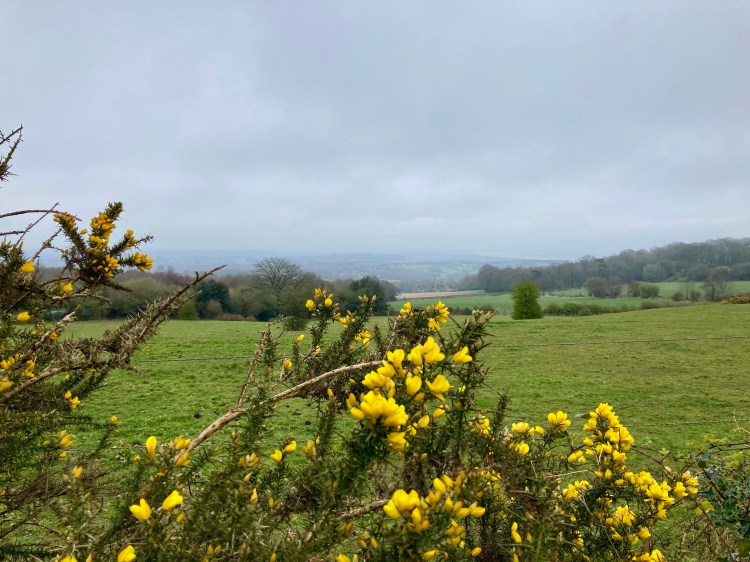
  • My eyes ranged across the landscape, observing where the fields rolled down towards the sea (grey today and almost indistinguishable from the sky), seeing a cluster of farm buildings and some patches of woodland.
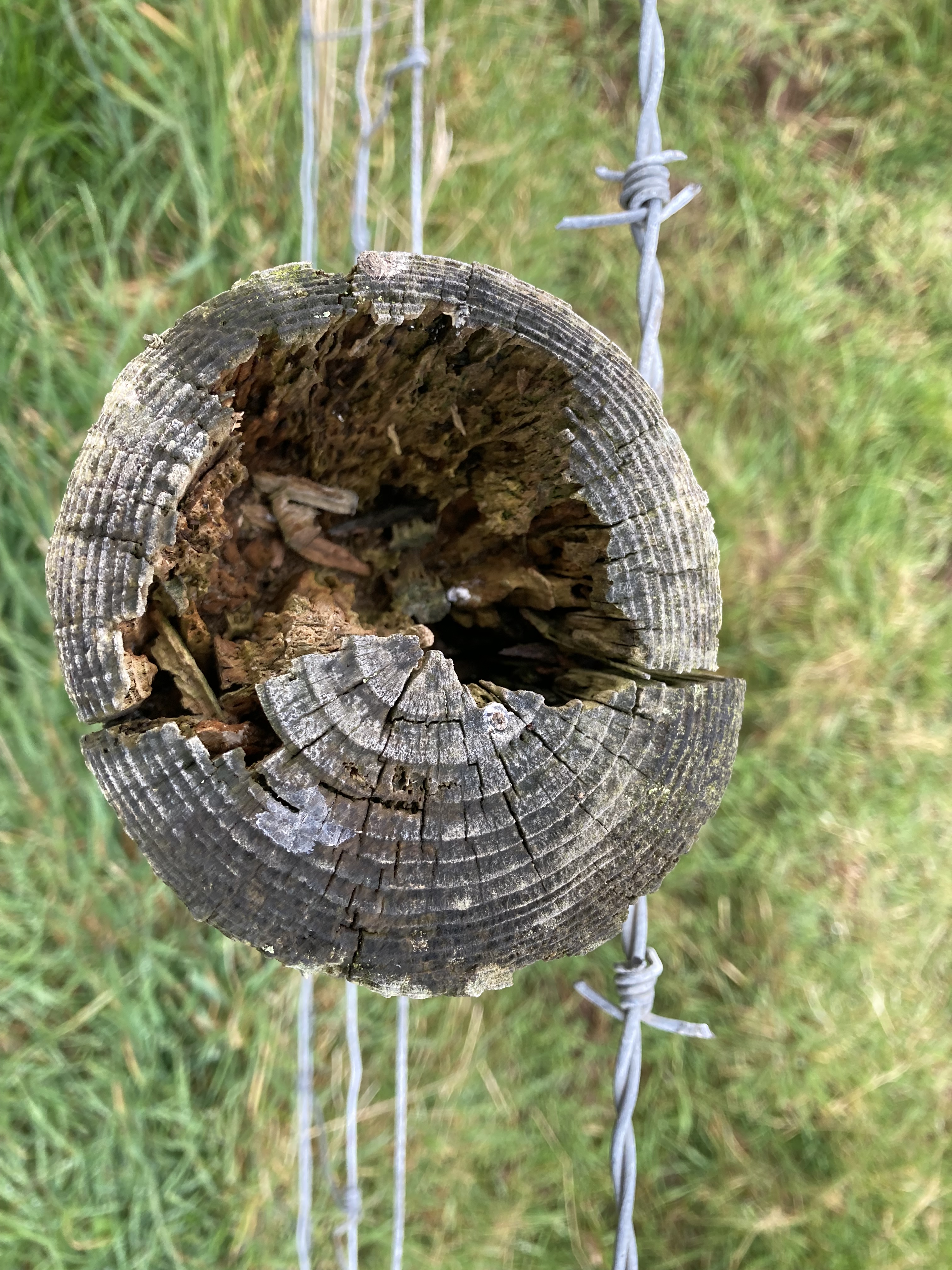
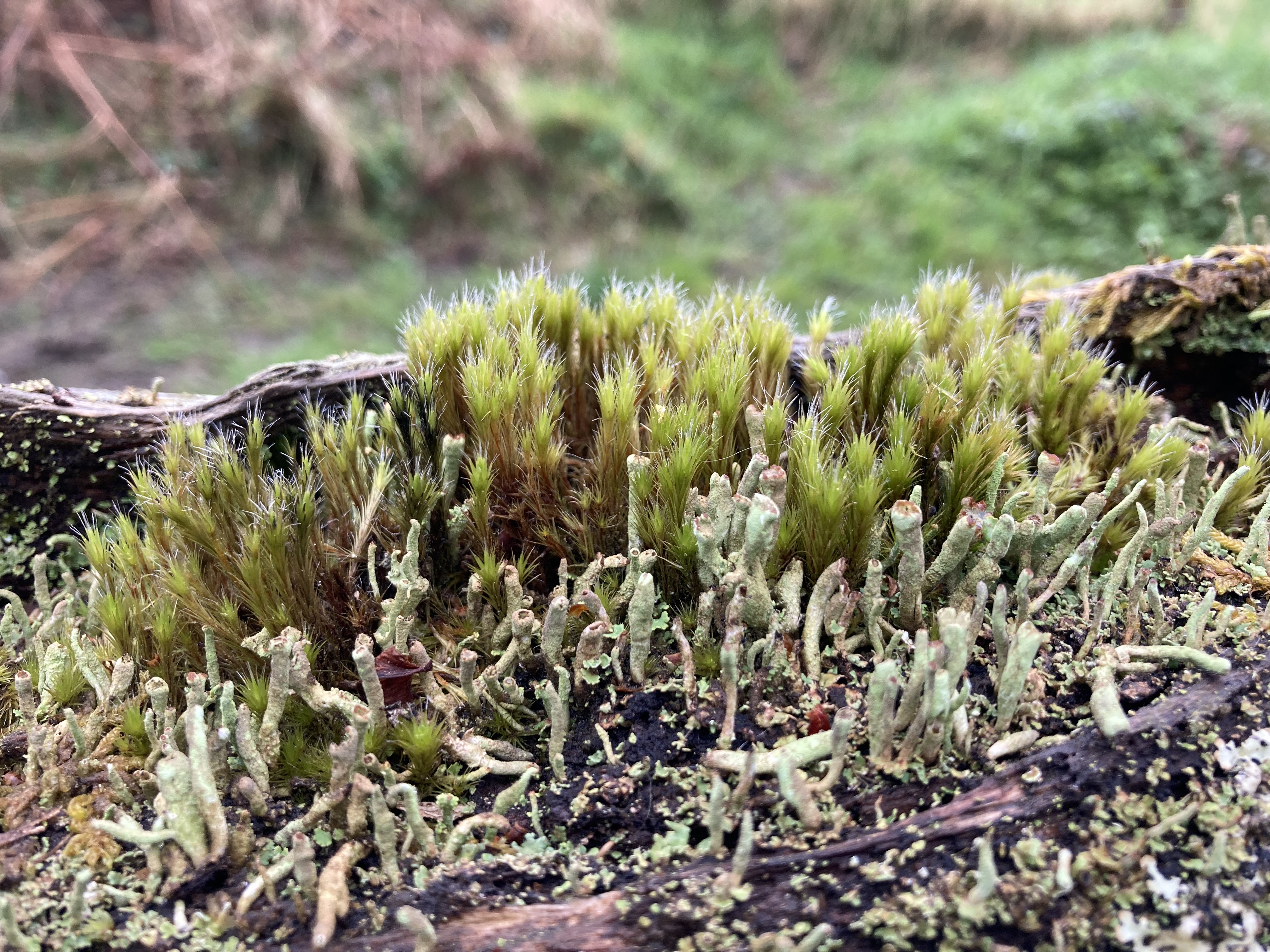
  • I also took in details close at hand: the grain of the wood of the fenceposts, emerging flowers, animal footprints in the mud, a drop of raining clinging to the underside of barbed wire.

My field of awareness ranged from the pulsing of blood in my circulatory system to the far horizon and beyond into the unseeable distance. On some level I was aware of it all. And I was part of it, not separate from the natural world, not separate from the earth and the sky, breathing it all in with my lungs, taking it all in through my senses. In this way my observations were less a checklist of countryside sights and more an affirmation of living, an affirmation of my place in the world.

It’s the same in seated meditation practice or in the movement practice of yoga. Many layers of awareness, from the subtle and internal through to the grand physical forms of the whole body, bring us more into to the present moment by focussing our attention. We become closer to the essence of ourselves, to a place we can truly feel at home — home within ourselves. With awareness of the full field of our consciousness, joy and peace naturally blossom when we take care and nourish them with our time and attention.

If you’d like to practise the art of paying attention with me (aka a short introduction to mindfulness), I am offering an online course in May/June. Just get in touch if you have questions, I’d love to hear from you!

In the flow

Vinyasa Yoga is often also called ‘flow yoga’, sometimes — unhelpfully in my view — equated with Power Yoga. In Vinyasa yoga postures are strung together so the transition between postures is seamless, using the breath to initiate the movements. In this way the transitions are as much part of the practice as any individual posture. There is no fixed sequence of poses, so the practitioner or teacher can adapt the practice to suit their personal need or inclination.

This style can be more or less physically challenging, depending on the poses included and the means of transitioning between them. Whatever the physical intensity, the aim is always to move with the breath, keeping breathing and movement smooth and measured. In this way a state of ‘flow’ might arise, so that the practice becomes something of a moving meditation.

‘The ‘flow ‘state’ of consciousness was famously defined by psychologist Mihaly Csikszentmihalyi as “that place of being fully absorbed and highly focused” on what we are doing. Csikszentmihalyi himself recognized the similarity between yoga and the ‘flow state’:

“The similarities between Yoga and flow are extremely strong; in fact, it makes sense to think of Yoga as a… flow activity.  Both try to achieve a joyous-self-forgetful involvement through concentration, which in turn is made possible by a discipline of the body.” 

In yoga terminology we might think of the shift in meditative consciousness from focus (dharana) into absorption (dhyana).

A breakdown of the Sanskrit word is usually presented as ‘vi’ meaning ‘in a special way’ and ‘nyasa’ meaning ‘placement’. In a literal way this can be understood as referring to the linking of one asana to the next, and intelligent sequencing so that each asana or movement builds step by step on what came before to create a full, well-rounded practice each time, with more challenging poses being prepared for, mentally and physically. Understood as a philosophy, we could say that Vinyasa recognises the temporary nature of all things. We enter into a posture, are there for a while and then leave; eventually we come to realise the cyclical nature of experience as the physical forms repeat with variations.

At this point, you might be thinking that this all sounds a bit high-minded. Do we drop easily into a ‘flow state’ when we step on the yoga mat? Sometimes maybe, sometimes not so much. But it is perhaps the quest for physical grace and fluidity, the existential sense of losing ourselves in the moment coupled with the potential for a different, freer version of ourselves to re-emerge, the experience of forgetting our breath and settling back into it in savasana or meditation as we complete our practice… All this is what keeps us coming back in a cycle of always beginning again.

Seeing the detail

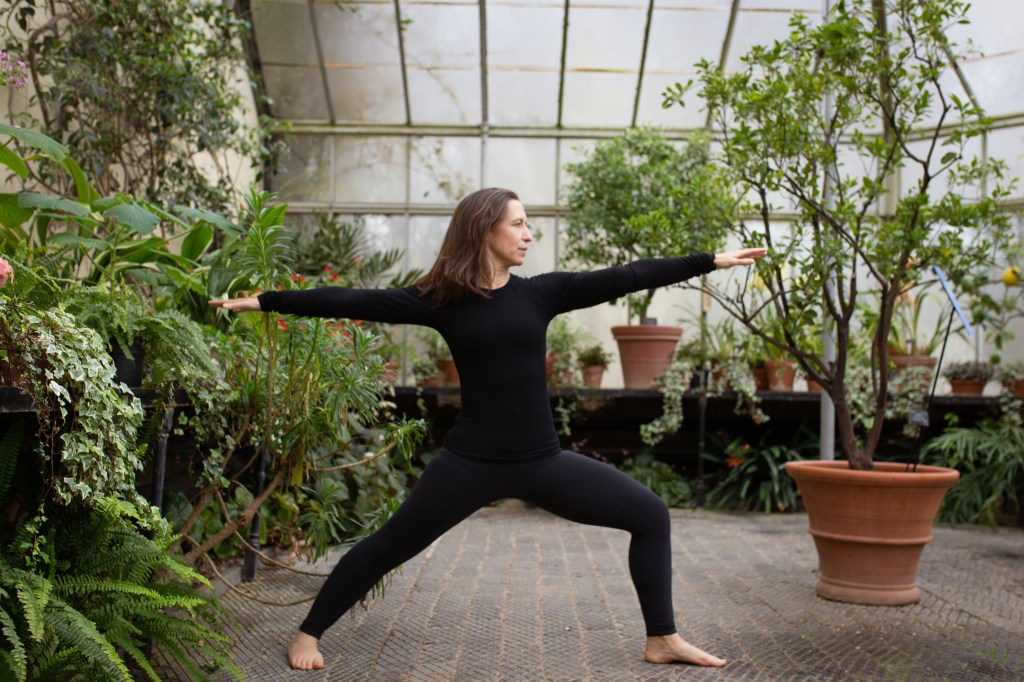
How long have you been practising yoga? Whatever length of time it is, whether months or a decade or more, one experience common to everyone is how many times you repeat common poses. In the vinyasa style sequencing is more creative than the set Ashtanga sequence for example, but even so many poses crop up in almost every class. Think about how many times you’ve done Downward Facing Dog or Warrior 2 or Child’s Pose. Not to mention ending in Savasana every time.

Does this mean the common poses get boring? I’d never thought of it like that, until a student asked me recently how I practise Warrior 2. Yes, the question was about how — she was curious about what I could still find of interest here. The implication behind the question was that I must surely have exhausted my enquiry into this pose and want to move onto other things that might be newer and more exciting. Actually I am still fascinated by Warrior 2, even after spending literally hours in this pose over the years of my practice. There’s always something new. Yoga poses evolve with us, our experience of them is ever-changing.

I still have vivid memories of the first time I tried Warrior 2 when I went to yoga class with a friend at university. The teacher and her assistant both helped me. They adjusted my stance, moving my feet with their hands, they supported my pelvis and encouraged me to reach out to the sides with my arms. Hey, I was doing the pose! Then they let go and stepped back and I simply fell over. They might have helped me form what looked like the Warrior 2 shape, but I had no foundations. I couldn’t yet stand on my own two feet — quite literally.

As the years passed I have accumulated much more experience of Warrior 2 and I have studied this pose deeply with my teacher, refining the physical actions and honing my attention so that I perceive the pose more fully. These days I’m much less distracted by learning to lift the arches of my feet or how to stabilise the front knee in good alignment. My experience of Warrior 2 has ceased to be a series of instructions aimed at engaging major muscles groups and turned into a more subtle, less physical experience. My current focus (to answer the student’s question) is on the drishti, the gazing point. How to orient my eyes towards the fingers of my outstretched hand (the middle fingernail, to be precise) not so much with my seeing eyes, but how to soften my eyeballs, so that I am looking inward as much as outward, merging myself with a sense of past, present and future… The outer form of my pose might not look so different but the inner experience shifts.

My Warrior 2 arises from all my accumulated experiences (on and off the yoga mat), from the willingness to pause repeatedly on my journey, to get down into the details and examine them closely and lovingly. There’s no rush to arrive; there’s just always more to discover. The yoga practice keeps in step with us and reveals more as our capacity for seeing develops. We are always exactly where we need to be. That’s why yoga works as a mixed-ability class. The same pose is different every time, and different for every body.

Warrior 2 photo credit: Ania Ready

Zoom room or studio?

I saw this bit of graffiti as I walked back from class this week. YOG. I laughed out loud. Something about the synchronicity, how this bit of vandalism paralleled my day, amused me. I was still laughing when I got home and my husband commented how different I was after my yoga class. He said I looked happy. More precisely he said I had a goofy grin on my face! I prefer to think of it as my ‘post yoga glow’.

I’ve only just started going to ‘real life’ classes again after more than a year of zoom and self-practice. I wasn’t sure how it would feel. The faff of getting ready, travel time, carrying a mat, as well as the covid protocols of spaced-out mats, hand sanitiser and masks… Should I bother? After all, I could just stay home and do yoga in my PJs.

But actually it was wonderful! There’s nothing like the feeling of being in class with other people. The sound of a gentle OM to begin, people gradually starting to move and warm up, then more synchronised surya namaskar as we found a rhythm, individual yet collective. Some challenging poses elicited a common groan and the room definitely got warm with us all sweating and focused on our practice. As we moved into the closing poses there were some low sighs around the room and finally we settled into our savasana and a beautiful stillness. The only time it feels right, as an adult, to lie down amidst a group of strangers and not worry about a thing!

Do you remember?

If you’ve missed in person classes and/or zoom doesn’t work for you, I’m teaching in person again with a weekly vinyasa class. I’d love to see you and share the energy of the room.

But don’t worry, zoom is also here to stay. In person can be great, but it’s also true that you can’t beat the convenience of a class at home before the working day. So let’s keep our Tuesday morning thing going — after coming together like this for more than a year, why change?

You decide what yoga you need: I’ll be there for both!

Yoga away from home

The continuation of online yoga classes means that it’s possible to keep up your practice and class attendance even when you’re away from home. If you’ve never tried yoga while you’re on holiday, you might be missing a treat! Provided that family or travelling companions can give you space for an hour (unless they want to join in with you!), the leisure of holiday time can make yoga feel more relaxed, rather than being something to cram in between working hours and mealtimes. And if you have time for a longer savasana to end, so much the better.

If tuning in for class doesn’t work, why not find some time for yourself and do your own practice? It’s easy to imagine that home yoga practice needs to look a certain way or be a certain level of intensity, but you might find that being on holiday and out of your usual routine (and mindset) some of these concerns melt away.

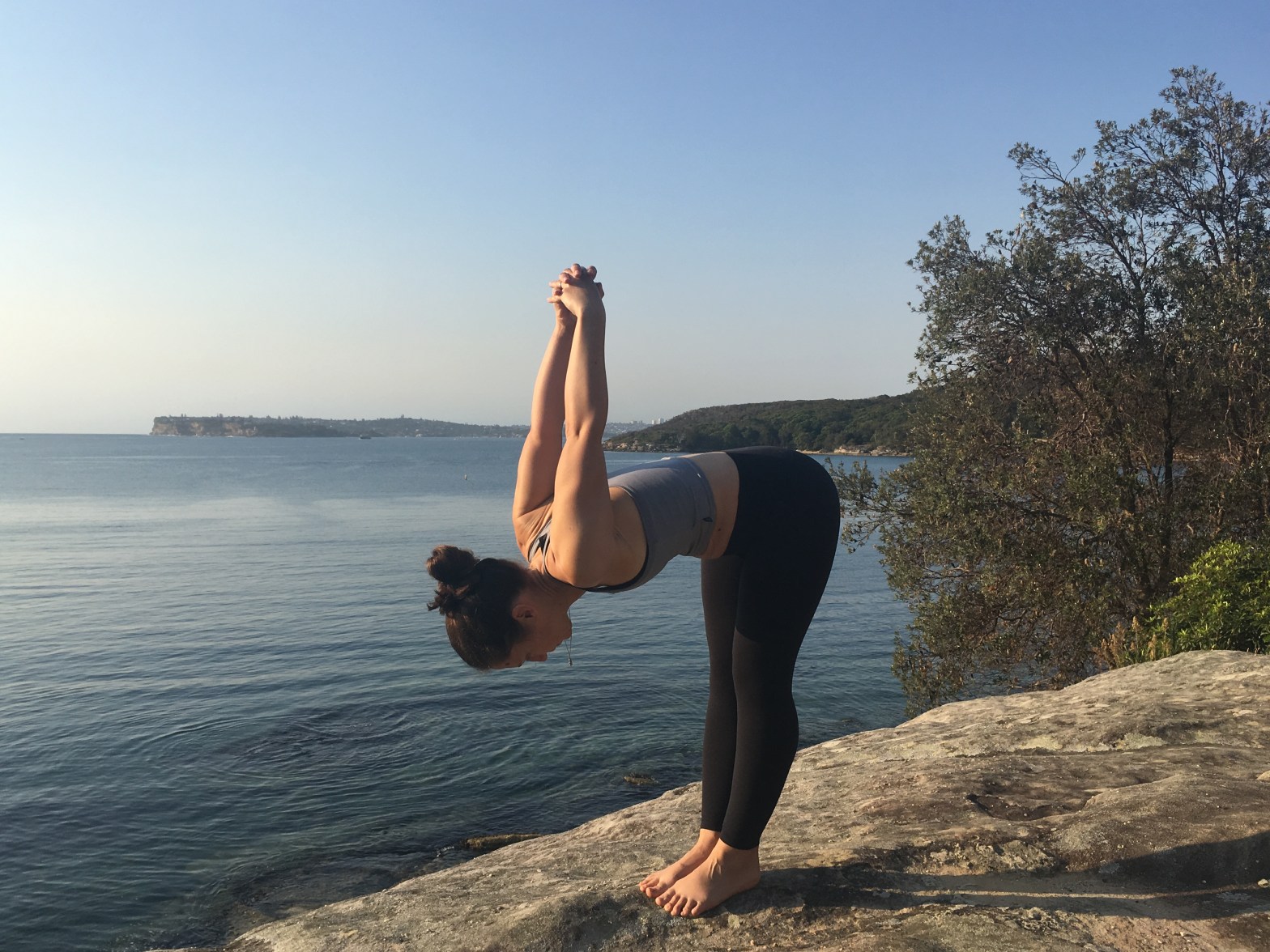
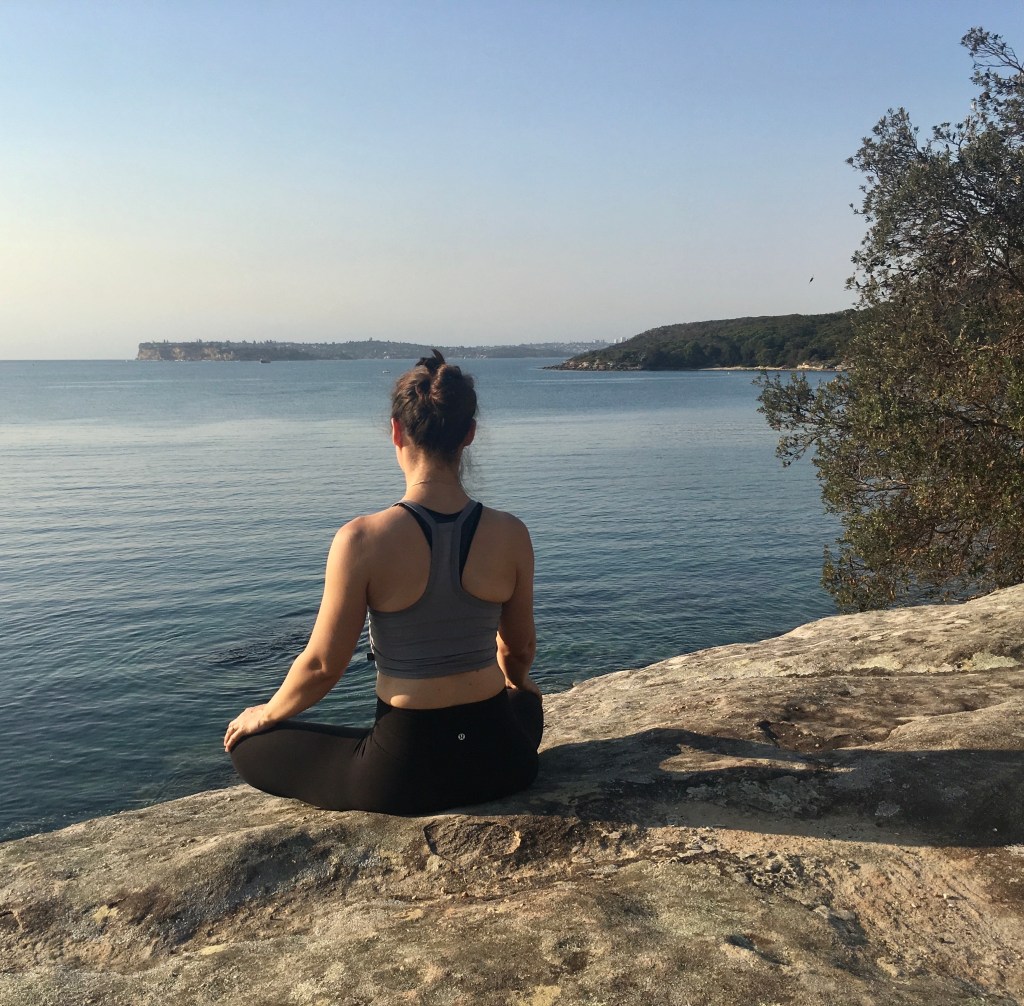
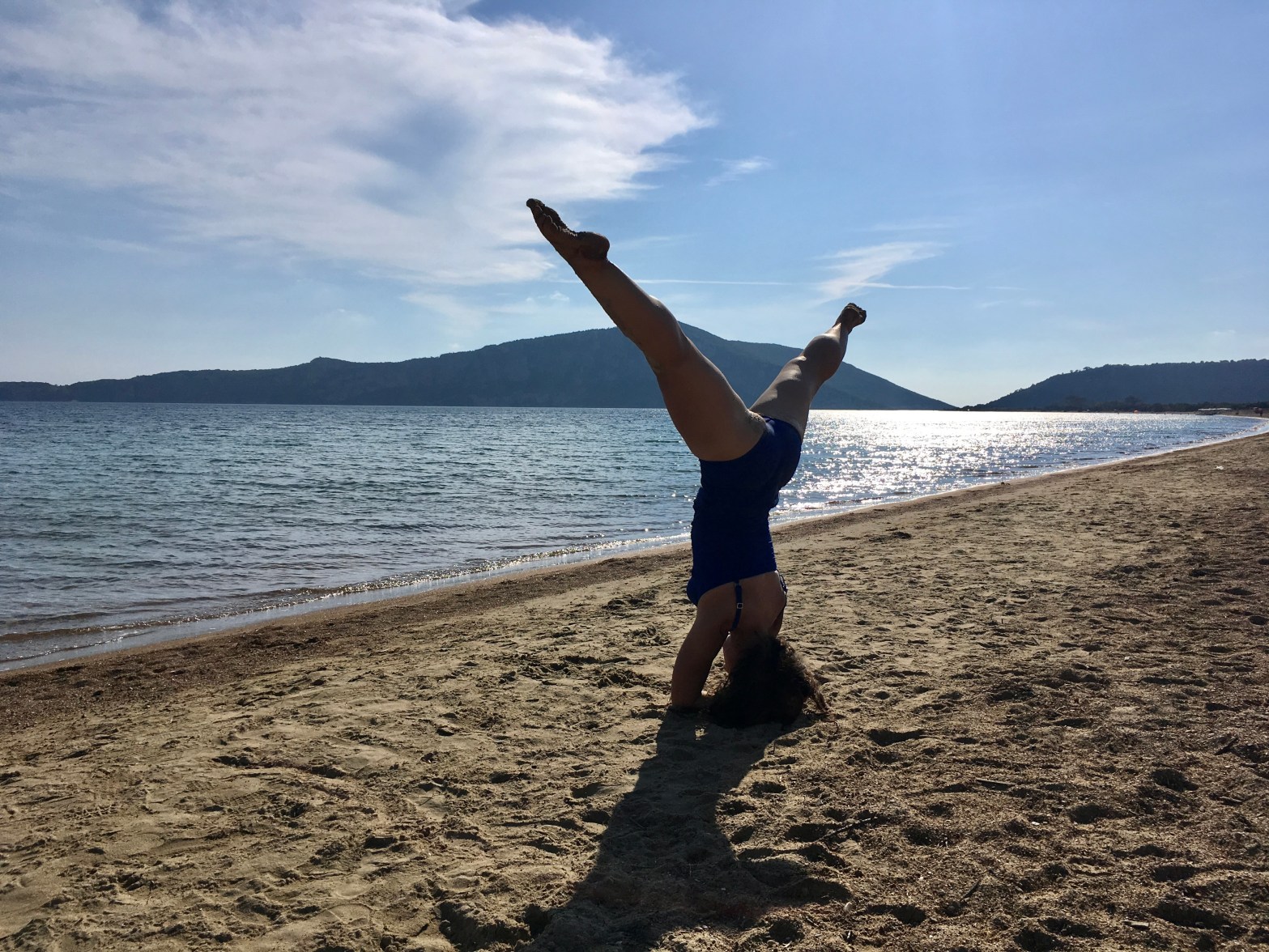
Find a clean, quiet spot, you don’t even need a yoga mat. A towel might work, or a patch of grass or sand…

Take some quiet breaths, without any particular intention or expectation. For the first practice in a new environment you might need a bit more time to settle, to ground, to absorb your surroundings and to feel safe.

Then you might begin some movements.

Start with something that feel familiar to you, from your own experiences. Some breaths in downdog might feel good especially if you’ve been sitting while travelling and feel the need to stretch out the back and the legs. Or you might take some stretches lying down. This can be particularly nice if you’re somewhere warm which might help the body feel softer or more flexible, or if you arrive tired and in need of some time to restore and relax after the inevitable busy days before the holiday starts.

Five or ten minutes like this might be all you need to feel refreshed and more connected with yourself. Or perhaps the holiday spirit has given you more energy and your movements become stronger or more dynamic and you increasing lose yourself in the joy of movement.

Holidays can be a great time to try something new, so don’t be afraid to experiment, to let go of old habits, trust your instincts about what’s best for you. You might come home with some new understanding of what your yoga is — that’s better than any suntan, I’d say!